CoolTown Studios

Wednesday, July 23, 2008

Maryland’s first pedestrian-only district


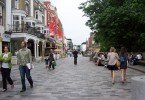
Ok, so those who’ve been down Silver Spring’s Ellsworth Drive in Downtown Silver Spring feel like they’re in Downtown Disney, but the takeaway here is that this is Maryland’s first successful pedestrian-only district (on weekends) in decades.

Ellsworth is the lone pedestrian-only street in the 22-acre mixed-use Downtown Silver Spring redevelopment, including 440,000 s.f. of retail. It’s more of a suburban shopping mall with its large-scale national retailers, but it does have a triangular plaza (left of photo above and in map) with a multitude of outdoor dining options amid a smattering of local, independent restaurants. In fact, the buzz is that as chains leave town in the weakened economy, they’re being replaced by local independents.


Posted by Neil Takemoto in • Pedestrian Only/CarfreeRetail Entertainment Districts | Link | Vote/Comment (0)

Thursday, March 20, 2008

London’s three public markets in one

London's three public markets in one


If you live anywhere near Notting Hill in London you may never have to shop anywhere outside of Portobello Road, where the Portobello Road Market comes to life each day. Over a half mile long and closed to cars, it features three distinct public markets:

Monday-Friday, 9am-6:30pm with half-day closing on Thursday, 1pm: Fruit and vegetable market, with flowers and food vendors, primarily serving the locals.

Friday, Saturday, 9am-6:30 pm: Flea market, with a strong emphasis on fashion new and old.

Saturday, 8am-5pm: Antiques market, known as the world's largest antiques market with over 1500 dealers.

Saturday is the most popular day, with the antiques and flea market running concurrently, sprinkled with unique street performers. The street is also lined with complementary local independent cafes, restaurants, pubs, galleries and shops.

Talk about longevity, the market has existed since the 1870s. Read about its history here.

Thanks to Travis and Andi Joseph for the reference.

Posted by Neil Takemoto in • Retail Entertainment Districts | (0) Comments | (0) Trackbacks | Link |

Monday, December 17, 2007

London’s car-free shopping day a huge hit

London's car-free shopping day a huge hit


What does $200 million have to do with cars? Absolutely nothing if you were in London's famous West End shopping district on Saturday, December 1st, known as Shop West End VIP (Very Important Pedestrians).

That's because 600 retailers on Bond Street, Oxford Street and Regent Street were open only for pedestrians, billed as the world’s largest area ever to be dedicated to shopping for the day. Not surprisingly, many retailers reported the best sales day of the year.

That's just the beginning. City and business leaders are pushing for more car-free days, and there's already a plan to make it permanent by 2013, no doubt aided by its preparation for the 2012 Olympics.

Open from 10:30 am to 8 pm, the event featured 1 million attendees and enjoyed $40 million more revenue than the previous year (this is the event's third year).

If there's any doubt that the event has garnered a wide and deep cast of support, read what the retailers themselves had to say here.

Image resource: Matteo C.

Posted by Neil Takemoto in • Retail Entertainment Districts | (1) Comments | (0) Trackbacks | Link |

Friday, October 19, 2007

Delaware seeks some creative identity

Delaware seeks some creative identity


The name 'Delaware' doesn't exactly roll off the tongue when naming places to be, so the folks in Wilmington had their work cut out for them. The transition of a neglected area into what is now being billed as the LOMA Design District is a good example of economic revitalization and destination building, but not a great model if you're sensitive to gentrification or a typical creative because most of you probably won't be able to afford living or leasing there. Think 'Meatpacking District' in Manhattan - beautiful, active nightlife, upscale.

The transformation of the LOMA district has the efficiency of a corporation, and that reflects the top-down lead taken by city government and business leaders. They brought in the ideal developers, such as Preservation Initatives and Struever Brothers Eccles & Rouse. They're investing in an entire streetscape renovation**. They built office space for over 500 workers. They're avoiding national chains (major kudos on that). They have a professional marketing program, coming up with the LOMA name and website.

However, what's missing is a little bit of soul and authenticity. The 'creatives' they're seeking are high end furniture sellers, architects (who seek out upscale venues), and marketing/design firms (ditto). As one retailer put it, "We're trying to hold the bar up really high, and set the standard for other businesses coming in." The new office space is all luxury/Class A. At least this may provide some momentum for the 'rest of the creative class', the majority, to crowdsource their own more relatable destinations somewhere nearby.

**The city seems to be stuck behind the trends. First, they implemented a pedestrian mall in the 1970s just as downtowns were draining of people, ensuring its demise. Now, just as pedestrians-only streets are starting to make a comeback amid an urban and green consciousness, they spent millions to tear it up to bring in auto traffic, a major missed opportunity at establishing an iconic regional destination. This likely wouldn't have happened with a beta community involved.

Posted by Neil Takemoto in • Retail Entertainment Districts | (0) Comments | (0) Trackbacks | Link |

Friday, October 12, 2007

A plan to recruit businesses to your retail district


Managing a town center/main street of local, independent businesses can sometimes be comparable to herding cats, so cities are grateful that organizations like the National Main Street Center provide experience in helping them prosper. Their plan for recruiting new businesses follows a four-part plan, presented here with a cooltown edge:

Assess: What have you got?
- Take a two-hour tour of the retail district as if you're seeing it for the first time and identify the good, the bad and the ugly;
- Create an online inventory of the buildings and businesses and display graphically what you have; complete a market analysis to find out what's supportable;
- Identify the trade area (where your customers are coming from) upon which to establish a beta community to really assess what the creatives want.

Agree Who should work together?
- Utilize beta communities to bring together the most progressive, creative, entrepreneurial - they are the 10% influentials that the other 90% listen to;
- Interview and survey stakeholders (key business and property owners, city officials, developers) to document what they prioritize;
- Work with property owners to agree on leases that help define the desired, unified vision for the retail district.

Plan
- Establish a Strategic Merchandising Plan (SMP) - the intentional selection of goods and services that are place in the most suitable locations available;
- Communicate whether current occupants fit the vision or not, and what both current and future vacancies could be filled with;

Act
- Prospect successful entrepreneurs that are interested in establishing new venues (ie VIBEs).
- Provide marketing programs for common themes (ie entertainment, furniture)
- Allow beta communities to crowdsource and crowdfund those new or repositioned businesses.

Read the August issue of Main Street News for many more details.

Image source: dezso.

Posted by Neil Takemoto in • Retail Entertainment Districts | (2) Comments | (0) Trackbacks | Link |

Thursday, October 11, 2007

The four sizes of urban retail-entertainment districts

The four sizes of urban retail-entertainment districts


When people talk about a retail entertainment district they either have in their neighborhood, or visited elsewhere and want in their neighborhood, it helps to be able to classify the scale. Thanks to New Urban News and retail consultant Robert Gibbs, here's a little retail primer (with a cooltown perspective):

Corner stores
Location: Within residential neighborhoods
Size: 1500-3000 s.f.
Offerings: Beverages, grocery items, sandwiches.
Minimum required population: 1000 households within walking distance.

Convenience centers
Location: Within residential neighborhoods
Size: 10,000-30,000 s.f.
Offerings: Food, personal services, local offices
Typical venues: Coffeehouse, cafe, deli, bakery, ice cream shop, bank, dry cleaner, florist, market, laundromat, mail center, liquor store, pharmacy
Number: 5-10 small, ground floor businesses
Minimum required population: 2000 households within walking distance.

Neighborhood centers (see image)
Location: Along major transportation corridors in between neighborhoods
Size: 70,000-90,000 s.f.
Offerings: Supermarket, full range of food, goods and services
Typical venues: Supermarket (45,000-60,000), restaurants, bars, shops, including a destination like a live music venue, small theater, microbrewery
Number: 20-40 small, ground floor businesses
Minimum required population: 6000-8000 households within walking/biking distance.

Industrial retail centers (rather than Community centers)
Location: Industrial districts away from residential neighborhoods
Size: 250,000-350,000 s.f.
Offerings: Big box types
Typical venues: Multiplex theater, supermarket, home improvement, office, books, sporting goods, discount department stores
Minimum required population: 50,000 people

Image source: Amersfoort, Netherlands main street by Captain Chaos

Posted by Neil Takemoto in • Retail Entertainment Districts | (0) Comments | (0) Trackbacks | Link |

Wednesday, July 25, 2007

“How can I keep chains out of my neighborhood?”

Ybor City, Tampa, FL

"How can I keep chains out of my neighborhood?"


It's a familiar refrain from urban creatives, such as the following one from a progressive developer, "How can you legally do this? Keep out the chains and corporate company's like Starbucks, the Gap, TGI Friday's, McDonalds, HARD ROCK CAFE'S! They are all part of the whole "Generica" movement, you could be anywhere in the country and not no where you are based on your surroundings. I want [our neighborhood] to be something you can't just get anywhere. How did other places keep out the chains?"

The answer is Formula Business Restrictions. Usually enforced by a Business Improvement District or Main Street Program, it's a ban not on chains per se, which to some would be considered a restriction of choice, but a ban on formula businesses, which are a restriction of choice. The formula laws require that incoming chains not look or operate like any other branch in the country.

Cities that restrict formula restaurant and retail businesses: San Francisco (on a neighborhood level); Fairfield, CT; Calistoga, San Juan Bautista, Sausalito and Coronado, CA; Bristol, RI; Port Townsend; Nantucket, MA; Port Townsend, WA; Portland, ME...

Cities that restrict formula restaurants only: Bainbridge Island, WA; Arcata, Carmel, Pacific Grove and Solvang, CA; Ogunquit, ME; Port Jefferson, NY; Sanibel, FL; York, ME...

See the New Rules report for the formula business restriction summaries for each of the aforementioned cities.

Thanks to Stacy Mitchell, author of Big Box Swindle, for the reference.

Posted by Neil Takemoto in • Retail Entertainment Districts | (2) Comments | (0) Trackbacks | Link |

Friday, July 13, 2007

Time for indie tenants to meet real estate investors halfway

Dieulefit, France

Time for indie tenants to meet real estate investors halfway


While it's time for real estate investment to catch up to the market", it's also time for local independent tenants to make it easier for developers to lease to them. The simple reason why an overwhelming majority of new developments prefer leasing out to national chains rather than local independent businesses is because chains can pay more rent, and that's because they have an established patronage once they open. This is why chains dominate our communities (and if not now, down the road they will), pretty much defining what is known today as 'Anywhere USA'.

How can local independent restaurants and stores compete with such a crippling disadvantage? They can use that same power of the brand, except instead of a national brand that brings in a loyal following on opening day, they need to focus on a community brand that brings in that loyal following on opening day, on what better way to do that than to establish a loyal following of several hundred loyal community customers before the business opens.

This is what a VIBE - beta community does, and here's a little press for a restaurant (Elements) in Washington DC by the Washington Business Journal. That party by the way, was last night, and the sense of community among the Element's future patrons was amazing, especially considering the restaurant doesn't even have a location yet. Let me know if you're a community resident and want to join up, or want to start your own.

Posted by Neil Takemoto in • InvestmentRetail Entertainment DistrictsRetail Venue Development | (0) Comments | (0) Trackbacks | Link |

Friday, June 29, 2007

Pike Place Market - most successful in the U.S.

Pike Place Market, Seattle

Pike Place Market - most successful in the U.S.


Why is that Seattle's grungy Pike Place Market is celebrating its 100 year anniversary as the longest running public market in the U.S., while the beautiful new Portland Public Market couldn't stay open for ten years even as public markets are flourishing?

Simple. Pike Place had a public partner in the city and is run as a nonprofit, while the Portland Public Market was completely private sector. Pike Place Market was founded by the city in 1907 after citizens who were tired of being taken advantage of middlemen demanded direct access to the producers. It was a success from day one. After a failed urban renewal attempt to raze the entire 9-acre market, the area was permanently protected as a historic preservation zone and the city established the nonprofit Pike Place Market Public Development Authority to run it, including apartments for 500 low-income residents/employees.

The result? Over 9 million people experience its 190 businesses, 120 farmers, 50 restaurants, and 240 street performers and musicians, as well as the famous flying fish at the Pike Place Fish Market. Of course, like any thriving destination, it has a regular slate of events: festivals, auctions, cooking demonstrations and its annual Sunset Supper, which is reminding of this outdoor dining scene in Sienna, Spain.

Posted by Neil Takemoto in • Retail Entertainment Districts | (0) Comments | (0) Trackbacks | Link |

Monday, May 21, 2007

Main streets go virtual to serve local community

Paris flower shop

Main streets go virtual to serve local community


We all know Amazon.com serves the world's goods, but how about if you just wanted to buy online from local neighborhood shops? Not only that, but what if delivery was free?! Well Pop to the Shops is another one of those 'it was a matter of time' services, though only in the UK.

What are the benefits to the consumer?
- Most local shops are open fewer hours and days, so this expands their hours to 24/7.
- Buy from all the stores in the neighborhood and pay once.
- Indie stores offer many items unavailable in chain stores or online, as well as items you would rather have delivered rather than shipped.

How does the Pop to the Shops make money?
They charge merchants 10-15% commission, which is pretty decent considering they wouldn't have to spend anything on marketing.

What are the benefits to the neighborhood?
- Economically speaking, a lot, as you can find out here - local stores give back 70% more to the community than chains.
- Culturally, it helps create more revenue sources to keep the unique indie stores around.

Image source: maody

Posted by Neil Takemoto in • Retail Entertainment Districts | (0) Comments | (0) Trackbacks | Link |
Page 1 of 8 pages  1 2 3 >  Last »