
If you’re passionate about walking, biking and living outside of the city, then you might want to check out what may be the very first new car-free community to break ground in the U.S. Modeled after remote pedestrian-only towns like Zermatt, Switzerland (see photo above and aerial of town here), it’s called Bicycle City, and its founders would like the initial development 15 miles south of Columbia, South Carolina to be the first of many.
It will be very similar to the Vauban neighborhood in
…
read more…
Now there’s a term you don’t hear very often, but you’re going to. Transparent real estate development. It’s a necessary first step towards open source development, which is when people not only get to see what’s going, but get to participate. This in turn is key for crowdsourced placemaking, when people determine what places they’re passionate about creating with others, and do so.
One of the most effective forms of transparency in real estate development is letting people know what’s going
…
read more…
Posted by Neil Takemoto in
•
Crowdsourcing |
Link |
Crowdsourcing often gets negatively associated with competitive websites that utilize a crowd to submit ideas in order to select one winning entry, and less so with collaborative efforts like Linux and Wikipedia.
So, we present a little video to help explain that there’s a difference between competitive crowdsourcing, collaborative crowdsourcing, and purpose-driven collaborative crowdsourcing, especially when it comes to placemaking.
The video also communicates that crowdsourcing is not
…
read more…
Posted by Neil Takemoto in
•
Crowdsourcing |
Link |
As part of the American Institute of Architect’s (AIA) Sustainable Design Assessment Team (SDAT) invited to East Bayside, Portland, Maine, here’s the section of the final report that explains how to establish a crowdsourced sustainability system, as summarized by this previously posted entry and video. Stay tuned for the AIA SDAT’s final report to be posted here. Why am I posting this? It may serve as a guide for other neighborhoods like East Bayside that want to attract investment, yet
…
read more…
Posted by Neil Takemoto in
•
Crowdsourcing |
Link |
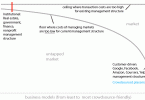
It may be easier to explain via diagram why the content of wildly successful services like Facebook, Google, eBay and Amazon are sourced by crowds, yet placemaking isn’t.
Based on economic models presented in crowdsourcing expert Clay Shirky’s Here Comes Everybody: The Power of Organizing Without Organizations, the key to whether or not an entity will crowdsource is based on its management and management structure.
On the x-axis, all business models are represented, from the least
…
read more…
Posted by Neil Takemoto in
•
Crowdsourcing |
Link |
Posted publicly on Facebook here, Keith Ammann’s question on how to go about crowdsourcing a creative cultural district in the small town of Freeport, Illinois, supported with detailed advantages and disadvantages, is followed by a suggested plan:
Summary of advantages: 3-4 block downtown with a mix of architectural styles; moderate vacancy rate; mixed-use zoning allowing for apartments over storefronts; established, locally owned businesses including two coffeehouses; a successful multiplex
…
read more…
Posted by Neil Takemoto in
•
Crowdsourcing
•
Reader Experiences |
Link |
If you’re selected to speak at TED, it’s because you’re changing the world. Katherine Fulton, President of the Monitor Institute, whose mission is to “help innovative leaders develop and achieve sustainable solutions to significant social and environmental problems,“, presented “You are the future of philanthropy”, but it could just as well have been titled, “You are the future of city building”.
This is a moment in history when the average person has more power that at any time. She further
…
read more…
Posted by Neil Takemoto in
•
Crowdsourcing |
Link |
Because crowdsourcing is defined as outsourcing a task to a community using an open call, you don’t necessarily need a community to start with. American Idol didn’t have a defined community to start, but crowdsourcing helped it create one.
With crowdsourced placemaking, it’s more relevant to use a task to help build a community as an end result, than having a community fulfill a task as the end result. Why? Because with placemaking, as they say, it takes a village. While a completed
…
read more…
Posted by Neil Takemoto in
•
Crowdsourcing |
Link |
For the purpose of understanding the evolution of our economy and our quality of life, if there was ever one definitive graphic, this is it. However, to understand the current creative, knowledge-based, whole new mind economy from an individual’s point of view, you have to get to know the work at ThinkStudio, a global think tank based in Switzerland.
The chart above illustrates the direct economy, where “customer knowledge is replacing producer knowledge”. ThinkStudio illustrates this
…
read more…
Posted by Neil Takemoto in
•
Crowdsourcing
•
Economic Gardening |
Link |
First we had the federal government funding crowdsourced placemaking solutions, and now they’re crowdsourcing transportation solutions! Who would have thought the federal government would be out-innovating the private sector.
Located in the U.S. Department of Transportation’s Research and Innovative Technology Administration (RITA), the Intelligent Transportation Society of America (ITS America) is sponsoring a $50,000 prize for the best crowdsourced solution to our traffic congestion
…
read more…
If even the federal government is funding a crowdsourced placemaking project, you know the private sector is getting a serious wake-up call. The resulting program, Crowdsourcing Public Participation in Transit Planning, is experienced predominantly through its website at nextstopdesign.com, which launched in the past week.
The U.S. Federal Transit Administration, under their 2008 grant program for Innovative Small Research Projects to Advance Public Participation Related to Public
…
read more…
On May 27, 2009 a group of people committed to crowdsourced placemaking held the first crowdsourced placemaking chat to see how the participants could work together nationally and internationally to help one another bring to reality the kinds of places we’d like to see built. See the word cloud of the chat above (click on it for larger image), and check out the transcript of the chat.
Some of the chat participants included:
Daren Brabham, a Ph.D. candidate at the University of Utah, heading
…
read more…
Posted by Neil Takemoto in
•
Crowdsourcing |
Link |
If we can hold onto a little bit of hope that there’s some truth to the notion that right-brainers will rule this century, let’s take a look at how the six main aptitudes of right-brain-directed thinking, aka the ‘Six Senses’, can be used to advance crowdsourced placemaking.
1. Design to complement function. If there’s one thing lacking in modern streetscapes, it’s design. Everyone knows of stumbling onto a strikingly beautiful interior of a building after being misled by a less than
…
read more…
Posted by Neil Takemoto in
•
Crowdsourcing |
Link |
Crowdsourcing is a powerful tool, and is fast becoming a standard way of getting what we all collectively want, even dream about. However, it isn’t the easiest to explain. So here’s a page dedicated to doing so in multiple ways, at multiple levels.
What’s the official definition?
According to the Jeff Howe, who coined the term in 2006 via his Wired magazine article, the short version is “the application of Open Source principles to fields outside of software,“, and the long version is “the
…
read more…
Posted by Neil Takemoto in
•
Crowdsourcing |
Link |
The old ‘stick’ approach to making a difference in your neighborhood was to boycott a business that people felt didn’t deserve support. However, the organization Carrotmob has an alternatively fun and effective approach, using a ‘carrot’ and a mob to help businesses become what the both the neighborhood residents and business owners want them to be, such as becoming greener.
The idea is simple, Carrotmob lets any number of businesses in a defined area bid on what % of their sales for a
…
read more…
Posted by Neil Takemoto in
•
Crowdsourcing |
Link |
Comment/Vote
(1)
For many, the image that first pops into people’s heads who have heard of cohousing is one of boomer hippies sharing communal meals every Sunday in their housing complex. The thing is, it’s a fairly accurate assessment for many of the only 110 cohousing projects in the U.S., and while it’s far from desirable for most people, there are some good lessons from its creation process, which is very relatable to crowdsourced placemaking. Here’s one Brooklyn story:
When a plan to build 40
…
read more…
If there was ever a concise, sticky way to explain the crowdsourced placemaking process, it’s the 1:9:90 rule. Here it is:
- 1 will create or contribute something.
- 9 will rate, edit or vote on it.
- 90 will use the result.
Explaining in more detail…
- 1 will create or contribute something. These are the ‘supercontributors’, and as is evident here, represent only 1% of the community. Keep in mind that this isn’t 1% of the population, but 1% of an identifiable crowdsourcing community, like
…
read more…
Posted by Neil Takemoto in
•
Crowdsourcing |
Link |
On the one hand you have the good ol’ boys network. On the other hand, you have diversity. Obviously, the title of this entry hints at the answer, but it’s not that simple. Here’s a story from Crowdsourcing: Why the Power of the Crowd Is Driving the Future of Business that illustrates this:
The founders of Marketocracy established an online stock market that allowed its members to use ‘monopoly money’ to make trades. The top 100 performers, known as the Marketocracy Masters 100, formed the
…
read more…
Posted by Neil Takemoto in
•
Crowdsourcing |
Link |
Comment/Vote
(2)
How does one apply a successful crowdsourcing model to placemaking?
In the previous entry, we profiled Threadless, a $20 million t-shirt company that crowdsources its designs. We talked about how the benefits are similar for t-shirts and placemaking (we’ll use housing as an example), but how does that serve as a framework in crowdsourcing cool housing for creatives?
First, you have to even the playing field. Shirts are mass produced and creative buildings (that’s all we’re talking about
…
read more…
Posted by Neil Takemoto in
•
Crowdsourcing |
Link |
What do t-shirts have to do with creating places? Since we were recently on the subject of t-shirts that expressed the love of certain places, it’s a good segue to profile a crowdsourced t-shirt company that’s a favorite of creatives.
In 2000, student Jake Nickell was feeling the priceless euphoria of having won a t-shirt design competition. Why not let others in on the emotional high? He presented the idea for a t-shirt company based on such a competition to future partner Jacob DeHart,
…
read more…
Posted by Neil Takemoto in
•
Crowdsourcing |
Link |
Continuing our look at the 12 principles for crowdsourced placemaking beta communities based on Airoots/Eirut’s 12 principles of architectural participation which were in turn based on the Linux open source community...
The first six.
The last six:
7. Communicate: This is what open source is all about - the ‘sponsor’ providing the business plan and updates as if it were a co-op, and listening to their members just as well. Here’s an example from a beta community agreement in New Orleans:
…
read more…
Posted by Neil Takemoto in
•
Crowdsourcing |
Link |
Comment/Vote
(0)
What are the principles for crowdsourced placemaking? One way to determine that is to take Airoots/Eirut’s simplified 12 principles of architectural participation based on the Linux open source community (a pioneer of crowdsourcing) and apply it to crowdsourced placemaking... and more specifically beta communities. So here’s Airoots/Eirut’s 12 principles in bold, followed by a beta community application.
1. Need It: Define the project’s vision, based on what’s collectively needed in the
…
read more…
Posted by Neil Takemoto in
•
Crowdsourcing |
Link |
Comment/Vote
(0)
While this site provides you 1400 vignettes on what crowdsource placemaking can create, it doesn’t provide you with the direct means to actually crowdsource these places. That’s no longer the case.
Join the CoolTown Network (see new green button in the right column) and create a new Group to start crowdsourcing the kind of place you’d like to see in your city or neighborhood. Is it a coffeehouse? A coworking site? Attainably-priced lofts? You define the vision, then start attracting people to
…
read more…
Posted by Neil Takemoto in
•
Crowdsourcing |
Link |
Comment/Vote
(0)
Following the announcement of a green home crowdsourcing program in July 2008, Taurus Enterprise Group, led by president Gail Montplaisir, has agreed to see if the building pictured above can be redeveloped and crowdsourced into green condos that creatives can truly afford. We’re not talking about ‘affordability’ in quotations, we’re talking about what first-time home buyers, those with average salaries or even recent graduates can literally afford to pay a month in order to buy their own
…
read more…
It’s pretty safe to say this is the video preview of the crowdsourcing book, considering the author is Jeff Howe, the person who coined the term crowdsourcing in the first place - via this 2006 article in Wired Magazine. Crowdsourcing: Why the Power of the Crowd Is Driving the Future of Business premieres on Tuesday, August 26, 2008.
Jeff’s definition: “Crowdsourcing is the act of taking a job traditionally performed by a designated agent (usually an employee) and outsourcing it to an
…
read more…
Posted by Neil Takemoto in
•
Crowdsourcing |
Link |
Comment/Vote
(0)