CoolTown Studios

Friday, February 27, 2004

The Next Small Town Boom Towns

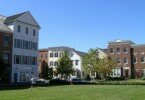
Harvard Square, Cambridge, MA

The Next Small Town Boom Towns

The other side to The Next Boom Towns? story is the focus on small towns (<1 million population).

Because of their size, they have to be much more innovative than the big cities that already have a headstart, and it shows:

#1 on the list is Boulder, CO.  Not only does it have some of the greatest recreational amenities anywhere, but it boasts one of the best-looking (at night), most-active small town downtowns in the U.S.

#2 is Fort Collins, CO.  I’ve never been there (comments

read more…


Posted by Neil Takemoto in • Cool Places | Link |

Thursday, February 26, 2004

The Next Boom Towns?

Harvard Square, Cambridge, MAThe Next Boom Towns?

Coincidentally enough, the magazine closest in content to Fast Company is Business 2.0 (though not nearly as innovation-focused), and their cover story this month is The Next Boom Towns?.

It has the usual high-tech big cities at the top in terms of job and population growth and median salary increase:  Raleigh-Durham, NC; San Jose, CA; Washington, DC; Austin, TX, Atlanta, GA… but of course you already knew this smile

What’s not factored in is, are people actually happy? 

read more…


Posted by Neil Takemoto in • Cool Places | Link |

Wednesday, February 25, 2004

CoolTown Resource: Fast Company magazine

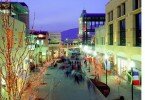
Santana Row, San Jose, CACoolTown Resource: Fast Company

If you want to understand the CoolTown market from a jobs point of view, it’d be helpful to subscribe to Fast Company magazine.

The magazine is a collection of stories about companies and people that are achieving success faster than their competition.  It’s not so much about speed as it is that they’re combining experience with innovation to perform at a much higher level than their peers.

It’s the only magazine that I’ve read cover to cover (as in every

read more…


Posted by Neil Takemoto in • Economic Gardening | Link |

Tuesday, February 24, 2004

What is New Urbanism?

Santana Row, San Jose, CA

What is New Urbanism?

Building a great community is much, much more than just the buildings, streets and public spaces, but it’s still a major part that’s often overlooked and misunderstood.  So, if you’re looking into what makes a compelling physical place, New Urbanism is the ideal benchmark and resource.  Click here for an informative tour.

In a nutshell, it’s about building places that prioritize people rather than cars.  The directive is simple, but it’s also been hard to pull off, and

read more…


Posted by Neil Takemoto in • PlaceMaking | Link |

Monday, February 23, 2004

Smart City Radio - Weekly urban insights

Smart City Radio - Weekly urban insights

If you’ve got one hour a week to listen to other people who share many of the CoolTown viewpionts, you have to listen to Carol Coletta’s interviews at Smart City Radio - Weekly urban insights.
The people she interviews have achieved success in using innovation and creativity to make cities and urban life more attractive, from benchmark new school models, economic success through the arts, and efforts that promote entrepreneurial growth.  OK, so

read more…


Posted by Neil Takemoto in • Media & Resources | Link |

Friday, February 20, 2004

CoolTowns in Utah?

The Gateway, Salt Lake City, UTCoolTowns in Utah?

Many people believe Utah may be the most entrepreneurial state in the country - its Mormon values for individual success being a factor.

Joe Alfandre and I visited three towns in Utah this week:  Pleasant Grove, St. George and Logan.  Pleasant Grove valued revitalizing its downtown, though more from a historic preservation point of view.  St. George wanted to revitalize its downtown as a regional destination with some artistic, cultural excitement.  They both understood

read more…


Posted by Neil Takemoto in • Government Innovation | Link |

Thursday, February 19, 2004

Student vision for a CoolTown

Kentlands, Gaithersburg, MD
Since we define cool by what the future resident/tenant thinks, we* met up with some students last night at BYU to ask them just that.

The collective vision of the 15-20 students was similar to the image above.  Understanding that this is BYU (ie Utah), many of the students were already married and thinking about kids, so it may be rather surprising that two-thirds of them preferred multi-family attached townhouses/lofts, with the other third preferring single-family, though either still

read more…


Posted by Neil Takemoto in • University Towns | Link |

Wednesday, February 18, 2004

Q&A: Which comes first?  A city-wide master plan or a built project?

Banff, CanadaQ&A: Which comes first?  A city-wide master plan or a built project?

This was asked by a city manager when discussing where to focus initial CoolTown investment.
The answer for the public sector is obvious:  The city-wide master plan.
The answer for the private sector is obvious:  The built project.

The CoolTown answer would be both, and more specifically, to build a touchstone CoolTown neighborhood that raises the standards for how the rest of the city could be master-planned, ideally

read more…


Posted by Neil Takemoto in • Government Innovation | Link |

Tuesday, February 17, 2004

Q&A: How do you build for younger audiences when the boomers are in charge?

Banff, CanadaQ&A: How do you build for younger audiences when the boomers are in charge?

I’m in Utah this week visiting small towns that may by interested in the CoolTown concept

This was asked by an economic development director when the idea of revitalizing a long-ignored downtown with gen xers/yers was introduced.

The simple answer is that we’re not asking the younger crowd to take charge.  We’re just focused on better providing for what the customers want, and in many ways, the younger generation

read more…


Posted by Neil Takemoto in • Market Development | Link |

Friday, February 13, 2004

Q&A: How do you build a CoolTown in an area considered rural?

Banff, CanadaQ&A: How do you build a CoolTown in an area considered rural?

Some people move to specific places because of a job they couldn’t get anywhere else within their desired area.  Others move because of recreation they couldn’t get anywhere else in the area.

People move to/visit coastal towns for the beach, mountain towns for the skiing and river towns for the fishing and boating.  Now, since affordability is such a fundamental element of fast-growth prosperity, think of how people with limited

read more…


Posted by Neil Takemoto in • Health & Fitness | Link |

Thursday, February 12, 2004

Medici: Godfathers of the Renaissance

Must See TVMedici: Godfathers of the Renaissance

Must see TV.

PBS broadcast the first of two 2-hour parts of Medici: Godfathers of the Renaissance just last night.  If you’re looking for some inspiration (minus the medieval bloodshed) to attract the kinds of creatives that can manifest a renaissance in your town, this is good watching.

The Medici were a rather humble family that rose to power in Florence through a matter of luck, relationship building and business acumen.  The Renaissance literally

read more…


Posted by Neil Takemoto in • Entertainment & ArtsMedia & Resources | Link |

Wednesday, February 11, 2004

Q&A: How do you attract the anchor R & D tenants?

Street in Florence, ItalyQ&A: How do you attract the anchor R & D tenants?

This is a more specific question related to job creation, asking how a city can attract the large companies that bring in hundreds or thousands of jobs in one shot.

Hewlett-Packard CEO Carly Fiorina said it best, “Keep your tax incentives and highway interchanges, we will go where the highly-skilled people are.”

Think about it, if you’re the CEO of a company that’s based on innovation (Research & Development), you’d conclude that you need

read more…


Posted by Neil Takemoto in • Economic Gardening | Link |

Tuesday, February 10, 2004

Q&A: Shouldn’t people come before buildings?

Bowling Alone by Robert PutnamQ&A: Shouldn’t people come before buildings?

As a civic/community-building practitioner, I often observe a disconnect in how communities approach initiatives to create vibrant places. For instance, the popular place-based initiatives… with new urbanist designs often overlook the necessary visioning work on ‘softer’ issues, viewing (instead) the physical changes as the essential ingredients in community transformation. How will CoolTown integrate civic/community-building aspects within its

read more…


Posted by Neil Takemoto in • Community BuildingMass Customization | Link |

Monday, February 09, 2004

Introducing CoolTown Q&A

Bowling Alone by Robert PutnamIntroducing CoolTown Q&A

Here’s a new CoolTown blog feature:  As CoolTown Network members were sending in questions, I thought it’d be beneficial to more people if I answered them here.  It’d be even better if others provided their own suggestions and answers at the comment link below the blog …

read more…


Posted by Neil Takemoto in • Community Building | Link |

Friday, February 06, 2004

A welcoming glow

Shop in Siena, Italy

A welcoming glow

This is one of my favorite images from Siena, Italy.  Along the street illustrated in yesterday’s blog, this rather striking image is a model for a number of inspiring, yet uncommon storefront principles:

1. As blog regular Silus Grok commented yesterday, pointing light down saves energy…

2. Not only that, by using task lighting (subject specific) instead of general lighting, only the most appealing features are highlighted - in this case the merchandise, the window and

read more…


Posted by Neil Takemoto in • Retail Entertainment Districts | Link |

Thursday, February 05, 2004

Lighting up the night

Shop in Siena, ItalyLighting up the night

Other than the exquisite architecture of Siena, Italy, one subconscious reason why people continously gush over its beauty is its lighting.

Notice that with incandescent lighting you can tell that the lady’s coat is actually red.  The light fixtures (art pieces unto themselves) are just a few feet above eye level, better illuminating the street.  Acting as spotlights, the textures of the buildings are richly illustrated.

Beauty has a price in Siena.  The city uses

read more…


Posted by Neil Takemoto in • PlaceMaking | Link |

Wednesday, February 04, 2004

Yes, those buildings are looking at you

Center of nightlife

Yes, those buildings are looking at you

Whether you’re walking through downtown San Francisco, New Orleans, Paris or Rome, there just seems to be a level of comfort and security that you just don’t get in most cities.  Some people will say…
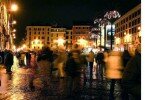
“It’s gotta be the windows”.

Just as we subconsciously gauge our comfort level by whether we’re surrounded by friendly faces and welcoming eyes, the buildings have a human character all their own… and the bottom line is, the more humanistic they are,

read more…


Posted by Neil Takemoto in • PlaceMaking | Link |

Tuesday, February 03, 2004

The Spanish Square in Rome

Piazza Di Spagna, Rome

The Spanish Square in Rome

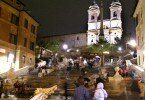
This is one of my favorite third places in Rome, the Piazza Di Spagna, or the Spanish Square.  The area is most commonly known as the Spanish Steps (the actual steps are to the right, off picture), as highlighted in yesterday’s entry.

Notice the amount of street life even at 40 degrees F.  The Piazza Di Spagna’s grand stairs, the neighborhood-sized piazza shown here, and another more intimate one facing it provide a vibrant stage for city life.  Then there’s this

read more…


Posted by Neil Takemoto in • Third Places | Link |

Monday, February 02, 2004

People-centric centers

Center of nightlife

People-centric centers

That’s what a neighborhood or town center should be - a center for people, not cars or monuments or overdone design and landscape architecture.  The best towns have dozens and dozens of them.

That usually means architects need to leave the talent to the people who will inhabit these spaces, as inherently counter-intuitive as it is for them.  In other words, imagine how impossible it would be to perform on a stage that was already completely filled with someone

read more…


Posted by Neil Takemoto in • Third Places | Link |
Page 1 of 1 pages